
Novels and Short Stories
Discover your next favorite ebook or fiction book with Redfiend Publishing, where we specialize in publishing unique stories and insightful content. Join our thriving community of readers and authors, including talents like Alexander Theroux and David Vardeman, today!
An Angel of Sodom – David Vardeman

Available now on Smashwords, Barnes & Noble, Kobo and Amazon!
An Angel of Sodom is the title of a short novel followed by 13 unique stories, all authored by David Vardeman—a writer who has long been overlooked yet continuously engaged in his craft. Now published by Redfiend Publishing, this distinctly indescribable author brings forth a haunting presence in the literary scene with his perverse, absurd, and realist tales centered around Midwestern, US American human experiences. These narratives delve into the lives of individuals who navigate their mundane quotidian existence while grappling with the most complex challenge of all: living sanely. In each story, the characters appear befuddled by the ordinary, while an unseen, enigmatic force subtly pulls at them.
What often goes unnoticed by the characters is something that Vardeman skillfully captures. His writing offers a range of pleasures, including humor and thought-provoking puzzles that induce discomfort, but his greatest strength lies in his ability to deliver endless surprises. With every turn of the page in his fiction books, readers are met with unpredictable reactions, urges, enlightening moments, petty cruelties, and rare instances of tenderness—moments that stand out as truly unique, especially in a world where such tenderness is fleeting. Dive into Vardeman's ebooks for a captivating experience.
an impalpable certain rest – Jeff Bursey

Available now on Amazon!
In the gloom of marginal lives, the haunted men and women of an impalpable certain rest are menaced by and fighting against the corrosive power of illusions and their own half-understood natures.
Apart from the intensity of these psychologically oppressive stories and their provocative, unsettling effect, what most astonishes in this collection are the intermittent, unexpected flashes which could be hope or delusion.
Badass Mizia – Lauren Fairbanks
Printed in color and available now on Amazon!
Artemisia Gentileschi was a highly acclaimed seventeenth century painter. In Badass Mizia, the author delves into the life and work of the painter, a woman who suffered greatly at a young age in a period when the achievements of women were not recognized and easily diminished. This novel reimagines her parentage, her relationships with her father, contemporaries like Caravaggio, her achievements and ultimate triumph. By way of a series of urgent, confessional monologues, Lauren Fairbanks provides a kaleidoscopic view of the life and times of an extraordinary painter, ‘a she-wolf representing the darkness, the lightness of all women.’ Gentileschi and her circle offer accounts of their traumas and triumphs in a quirky style that is both Baroque and modern. There is insightful art criticism on both Gentileschi and her fellow painters, and sharp social criticism of the role of women in patriarchal society.
Cafe by the Edge of the Moon – Gargee Baruah
Available now on Amazon!
Cafe by the Edge of the Moon is a chance through dead ends, speaking with Desire from inside a clenched fist. The mysticism of magic breathes through the bodies of intelligence, hidden and conscious, unfolding across manifold paths, just as humanity chases questions of essence and existence. Desire drops like a bomb that annihilates, only to arouse fever births and retro shamanism.
Cynicism Management – Borut Praper
Available now on Amazon!
A satirical tour through contemporary Europe, from the Orkney Islands, to airport toilets, Slovenia, and, well, either Africa or the Middle East, for two plots are misaligned in the manner that our dystopian modernity manages quite easily. If you have a tattoo on your ass, you might be of more interest than you ever wanted to be as a musician. Ironically, the music is actually produced, laced throughout the novel, and is available through some mysterious processes younger people than I will have no difficulty navigating. That must make this meta-publishing. The plot of the novel is thoroughly senseless, yet easy to follow, as it amounts to a satire involving recognizable 21st century humans being manipulated by opaque forces, and generally running about attempting to avoid senseless annihilation. It is not history, but neither, unfortunately, is it fantasy. There is indeed an evil corporation called Omnipile, and that alone should sell the book to any remaining thinking primates. The virtual need to compare the book to John Kennedy O’Toole’s suicide not is prevented by the insistent repetition of Bob Dylan sardonic comment after meeting Columbus: I just said good luck.
Letters of Thanks from Hell – David Vardeman

Available now on Smashwords, Barnes & Noble, Kobo and Amazon!
Letters of Thanks concerns a case of supposed witchcraft and demon possession in Boston, 1688. The incident serves as a prelude to the more famous witch trials of Salem and Andover 4 years later. The Puritan Minster Cotton Mather, takes into his home a 13 year old girl, Martha Goodwin, recently cursed by condemned witch Goody Ann Glover. The intransigent “witch” is condemned to death on specter evidence. Mather strives to save her soul. Meanwhile he and members of his congregation work to release Glover’s victim, Martha, from her supposed state of demon possession. His efforts work to the detriment of his reputation and the corruption of his home life, as will his influence over the Salem trials several years later.
MARGIE and the Atomic Brain, Book 1: Them – Zachary Tanner
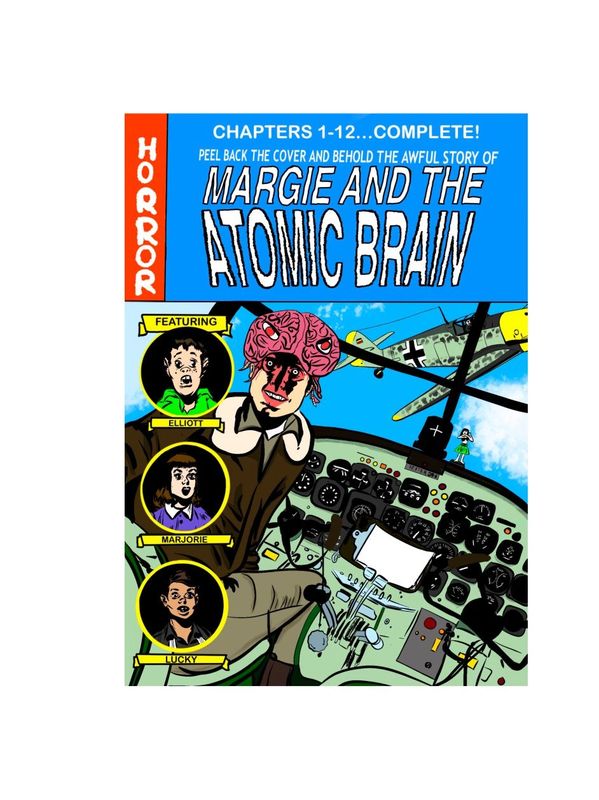
Available now on Smashwords, Barnes & Noble, Kobo and Amazon!
Book 1 in a series of six planned books. In the way it embellishes the implications of quantum physics in a narrative context, this series may be considered literature’s first true multiverse novel, existing as a superposition of ever bifurcating and contradictory moments lived and relived within a greater web of experience that cumulatively suggests the macro-/micro-cosmic nature of our own universe. The story situates fully-developed characters believably within a schlocky 50s B science fiction plot.
MARGIE and the Atomic Brain, Book 2: Atom Thing from Planet
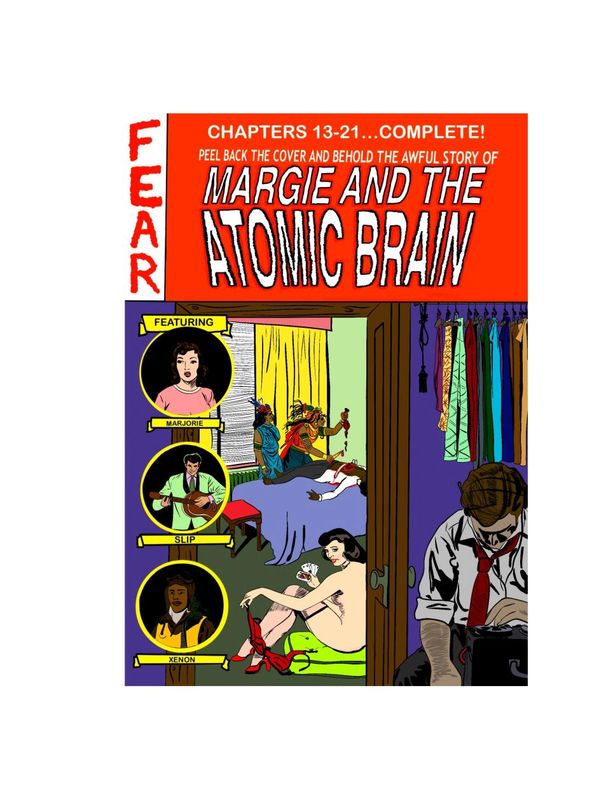
Available now on Smashwords, Barnes & Noble, Kobo and Amazon!
Book 2 in a series of six planned books. In the way it embellishes the implications of quantum physics in a narrative context, this series may be considered literature’s first true multiverse novel, existing as a superposition of ever bifurcating and contradictory moments lived and relived within a greater web of experience that cumulatively suggests the macro-/micro-cosmic nature of our own universe. The story situates fully-developed characters believably within a schlocky 50s B science fiction plot.